


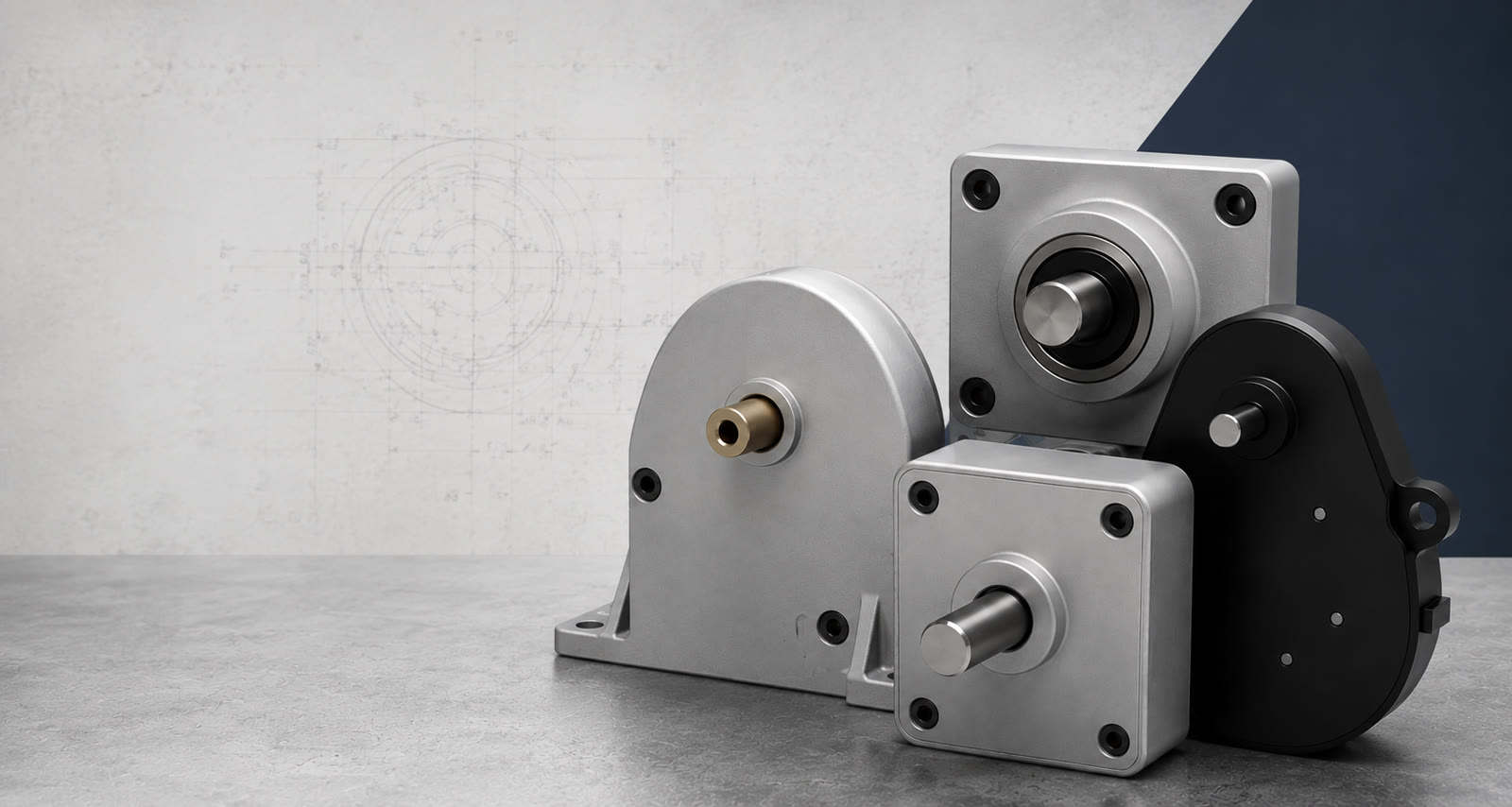
Types of gearmotors: differences, advantages and when to choose each one
Parallel shaft, planetary, 90°, harmonic or hypoid: we compare the types of gearmotors, their advantages and when to choose each one for your project.
There is no single “best” gearmotor: there is the one best suited to each project. The geometry of the shafts, the available space, the precision required or the acceptable noise level all point towards one type or another. In this guide we compare the main gearmotor technologies, with their advantages, their limits and their typical applications, so that you know which one best fits your application.
Why are there different types of gearmotors?
All gearmotors pursue the same goal —reducing the speed and multiplying the torque of a motor—, but they achieve it with different internal architectures. That difference in design translates into priorities: some maximise torque in a minimum size, others efficiency, others quietness and others the ability to change the orientation of the movement. Knowing those priorities is what makes it possible to choose wisely.
Parallel shaft gearmotors
How they work
In a parallel shaft gearbox, the input and output shafts run parallel to each other. It is the most widespread and versatile configuration, and the basis of a large part of industrial ranges.
Advantages and limitations
They offer an excellent balance between performance, size and cost, with a wide variety of reduction ratios. On the other hand, for very high torques or extremely tight spaces they may not be the most compact option compared with a planetary gearbox, for example.
Typical applications
They cover everything from light, precision mechanisms to demanding industrial applications. In CLR's case, they correspond to families such as the FGS Series (low torque and high precision), the MTS Series (medium torque and versatility) and the IGS Series (the most robust range).
Planetary gearboxes
How they work
A planetary gearbox distributes the load among several “satellite” gears that rotate around a central pinion. That distribution is the key to its performance.
Advantages and limitations
They stand out for their high torque density —a lot of torque in very little space—, their quiet operation and their great precision, with reduced backlash. In exchange, they usually have a higher cost per unit of torque than an equivalent parallel shaft solution.
Typical applications
They are ideal when space is limited, precision is required or the noise level is critical. CLR's range of planetary gearmotors responds precisely to that space-to-torque ratio.
Right angle (90°) gearmotors
When the orientation of the movement is what matters
In a 90° configuration, the output shaft forms a right angle with the input shaft. It is the solution when the orientation of the motor relative to the load is a constraint and an in-line arrangement does not fit in the machine.
Advantages and limitations
Their great advantage is the flexibility of integration into complex spaces and geometries. They do, however, require careful assessment of efficiency and torque depending on the variant chosen. At CLR they are offered as 90º Solutions, with versions in different materials.
High precision solutions: harmonic and hypoid
For applications that demand very high reduction ratios and extreme precision —such as robotics or fine positioning—, there are specific technologies. Harmonic reducers offer very high reductions with virtually zero backlash, while hypoid gearboxes combine high torque capacity with smooth transmission. Both technologies are part of CLR's catalogue for the most demanding projects.
Application-specific solutions
Beyond geometry, some ranges are designed starting from the constraints typical of a sector. That is the case of the solutions for the vending sector or of the mirror folding mechanisms in the automotive industry (powerfold), which incorporate the usual requirements of those applications as standard and save adaptation work.
Quick comparison by priority
To guide the first screening, this is the selection logic according to what matters most to you (the values are indicative; the final decision always depends on the specific data of the project):
- If you are looking for versatility and a tight cost for general use: parallel shaft.
- If you need a lot of torque in little space, plus precision: planetary.
- If the machine forces you to turn the orientation of the movement: right angle (90°).
- If your application demands extreme precision and very high reduction ratios (robotics): harmonic or hypoid.
So, which one do I choose?
The comparison helps to rule options out, but the final decision is made by cross-checking five variables: the torque required, the output speed, the geometry and the space, the operating conditions and the expected service life. We develop this step by step in our guide “How to choose a gearmotor”, which complements this article.
And when no standard range fits completely, a custom solution designed around the problem is usually the most efficient option in the long run.
Frequently asked questions
Which gearmotor offers the most torque in the least space?
The planetary one, because it shares the load among several satellite gears. It is the benchmark when space is very limited and a lot of torque is needed.
Which type is the quietest?
In general, planetary gearboxes offer quieter operation with less backlash, which makes them ideal when noise is a critical factor.
When do I need a right angle gearbox?
When the machine layout requires the output shaft to be turned with respect to the input shaft and an in-line configuration does not fit or is not suitable.
Not sure which type fits your project?
At CLR we have spent more than 40 years designing and manufacturing custom gearmotors. Tell us about your application and we will help you choose —or manufacture— the perfect drive solution. We manufacture your solution.
We offer customized, tailor-made solutions. Configure with us the perfect gearmotor for your project.
Do you have a project in mind?
We can manufacture your tailor-made solution, we accompany you at every stage of the project to offer the solution that best suits your application.
Do you have a project in mind?
We can manufacture your tailor-made solution, we accompany you at every stage of the project to offer the solution that best suits your application.

Joaquín Vilanova Avenue, 30
03440 Ibi, Alicante, Spain

+34 965553607