


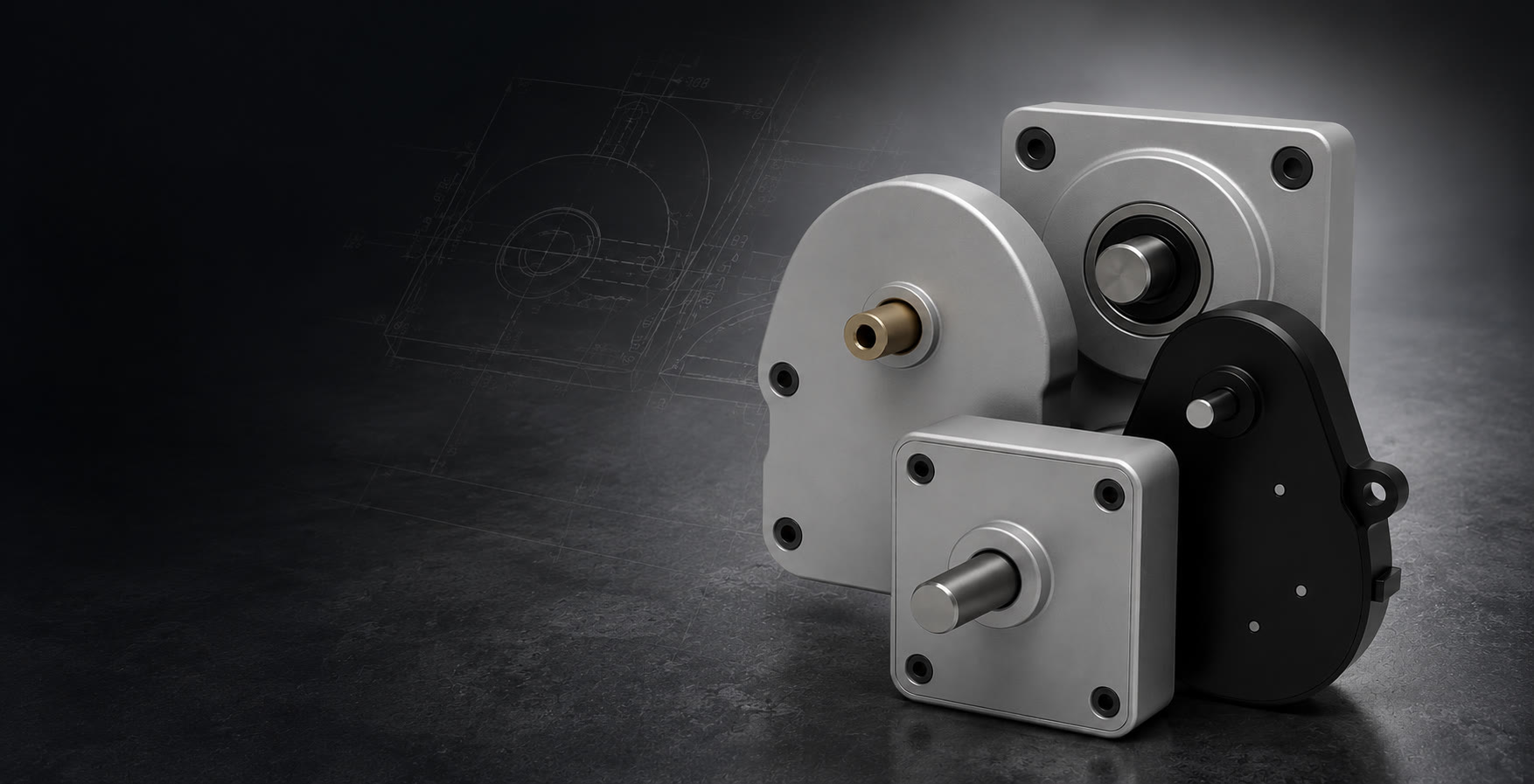
Choosing the right gearmotor is one of the decisions that most affects the performance, reliability and cost of a machine. An oversized component makes the assembly more expensive without adding value; an undersized one overheats, wears out prematurely and compromises the entire project. In this guide we go step by step through the technical criteria worth having clear before you decide, and how they steer the choice towards one solution or another.
What is a gearmotor and why does choosing the right one matter?
Motor and gearbox: how they work together
A gearmotor is the assembly formed by a motor and a speed reducer integrated into a single unit. The gearbox adjusts the output speed and multiplies the available torque, so that the same motor can move very different loads depending on the reduction ratio. In practice, it is the heart of the machine's drive system.
The cost of a poor choice
Choosing the right gearmotor is not just about moving a mechanism, but about doing so with the right torque, at the correct speed, within the available space and throughout the expected service life. A rushed selection translates into overheating, noise, premature wear or line stoppages; an oversized selection, into an extra cost that is carried over into every unit manufactured.
The 5 criteria for choosing a gearmotor
These are the five factors that, properly defined from the outset, make it possible to get the selection right and avoid having to redo it later on.
1. Torque: the starting point of the selection
Nominal torque versus starting torque
Torque is the rotational force that the gearmotor delivers at its output shaft and is usually expressed in newton metres (Nm). It is the first figure to define, because it determines whether the assembly will be able to move the load. It is worth distinguishing between nominal torque —what the unit delivers continuously— and starting or peak torque, which can be considerably higher during brief moments, such as starting under load.
How to apply a safety margin without oversizing
Good practice is to calculate the torque required by the application and add a reasonable safety margin, avoiding both falling short and going too far. In catalogues such as CLR's, each family covers a clearly defined torque range: from low-torque, high-precision solutions to industrial ranges of tens of newton metres.
2. Output speed (rpm) and the reduction ratio
The torque-speed pairing
Output speed, in revolutions per minute (rpm), defines how fast the shaft turns once the reduction has been applied. Together with torque, it forms the essential pairing of the selection: the greater the reduction, the lower the output speed and the higher the available torque, and vice versa. They cannot be decided separately.
Constant or variable speed?
It is worth being clear about the speed range the application needs and whether it must remain constant or vary during the duty cycle. Many projects call for a compromise: the reduction ratio that delivers the necessary torque at the desired working speed. Defining both values from the start saves iterations.
3. The type of gearbox according to the project geometry
Not all gearboxes solve the problem in the same way. The arrangement of the shafts and each project's priorities —space, quietness, precision or power— point towards one technology or another.
Parallel shaft gearmotors
The most common and versatile option when the input and output shafts are parallel. They offer a good balance between performance, size and cost, and cover everything from light applications to demanding industrial uses.
Planetary gearboxes
They stand out for their high torque density in a compact size, their quiet operation and their good space-to-torque ratio. They are ideal when space is limited and precision is required.
90° solutions
When the orientation of the motor relative to the output is a constraint, a 90° configuration makes it possible to fit the drive into geometries where an in-line arrangement would not fit.
Application-specific solutions
There are also ranges designed for very specific requirements —such as those aimed at the vending sector or at mirror folding mechanisms in the automotive industry—, which already start from the constraints typical of that use.
4. Available space and mounting constraints
Dimensions, shaft and mounting system
In most machines, the gearmotor does not work alone: it shares space with other components. The dimensions, the shape of the shaft, the mounting system and the mounting orientation can be just as decisive as the torque itself. A unit that is perfect on paper but does not fit physically is not a solution.
When the standard range does not fit
That is why it is advisable to define the project's dimensional constraints early on. When the standard catalogue falls short, the way forward is a custom solution that adapts to the actual space available, rather than redesigning the machine around a component.
5. Operating conditions and expected service life
Duty cycle and operating environment
The environment has a direct influence on durability. Before deciding, it is worth assessing the duty cycle (continuous or intermittent use), the ambient temperature, the presence of moisture, dust or chemical agents, the acceptable noise level and vibration. The same gearmotor can behave very differently in a logistics warehouse than outdoors or on a food production line.
Materials, protection and tolerances
Defining these conditions makes it possible to choose the right materials, protection ratings and tolerances, and to realistically estimate the service life of the assembly. It is the difference between a solution that lasts as expected and one that forces unplanned maintenance.
Standard or custom gearmotor: when to take the step?
A well-structured standard range solves most projects with tight lead times and budgets. But when several constraints come together —very limited space, an unusual torque, a demanding environment or a particular geometry—, the custom solution stops being a luxury and becomes the most efficient option. Designing the gearmotor around the problem, and not the other way round, avoids compromises that are paid for dearly over the life of the machine.
In these cases, having a manufacturer that supports you from the initial analysis through to series production —including prototyping and testing— reduces risk and shortens lead times.
Frequently asked questions about choosing gearmotors
Which is more important, torque or speed?
Neither on its own: they are chosen together. Torque ensures the unit moves the load and the output speed defines the working pace. The reduction ratio is precisely what reconciles the two values.
How do I know whether I need a custom gearmotor?
When the standard catalogue fails to meet a critical constraint —space, torque, geometry or environment— without forcing you to compromise the machine's design. If you find yourself adapting your project to the component, it is probably time for a custom solution.
What information should I have ready before requesting a solution?
Ideally: required torque (nominal and peak), output speed range, available space and mounting type, operating conditions (duty cycle, temperature, environment) and estimated volume. With that data, the selection —or the custom design— speeds up considerably.
Do you have a project in mind?
At CLR we have spent more than 40 years designing and manufacturing custom gearmotors for the automotive, intralogistics, vending and energy sectors, among many others. If you would like us to help you select —or manufacture— the perfect drive solution for your application, tell us about your case and we will manufacture your solution.
We offer customized, tailor-made solutions. Configure with us the perfect gearmotor for your project.
Do you have a project in mind?
We can manufacture your tailor-made solution, we accompany you at every stage of the project to offer the solution that best suits your application.
Do you have a project in mind?
We can manufacture your tailor-made solution, we accompany you at every stage of the project to offer the solution that best suits your application.

Joaquín Vilanova Avenue, 30
03440 Ibi, Alicante, Spain

+34 965553607