


Executive boards are investing millions of euros in artificial intelligence algorithms, cloud platforms, and digital twins. The promise is compelling: accurately predict when a production line will fail before it happens. Yet many of these ambitious IT projects struggle to deliver results once they reach the factory floor.
Why?
The answer often lies in what we call the blind software syndrome. No matter how advanced an algorithm may be, it is useless if the physical hardware responsible for motion cannot provide clean, accurate, and reliable data. The success of any data-driven strategy begins long before software—it starts with mechanics.
The First IoT Node Is Not a Router, It’s an Actuator
At the intersection of IT (Information Technology) and OT (Operational Technology), we often assume that data collection begins with external sensors or the PLC. However, the reality of the hyperconnected factory is different: telemetry should originate at the very point where motion is generated.
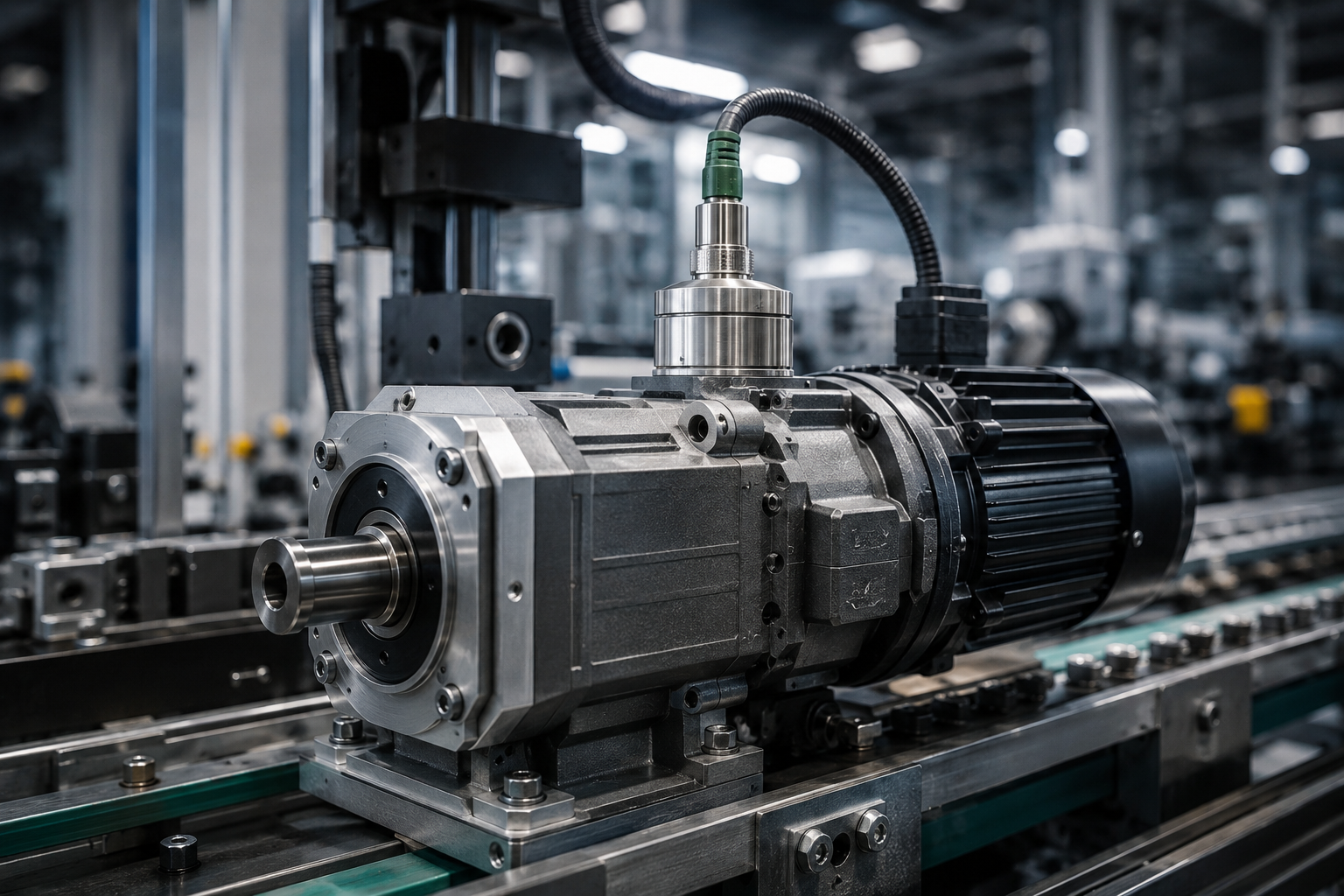
This is where the gearmotor ceases to be a simple metal component powered by electricity and becomes the first edge-computing node in the facility. By integrating analytical capabilities directly into the drive system, the physical component can detect power consumption peaks, resistance to movement, and micro-vibrations before any other element in the system.
Transforming an actuator into an intelligent node is the first step toward a truly effective predictive maintenance strategy. The closer data is captured to its source, the higher its quality and the more reliable the resulting analysis.
Translating Reality: The Importance of Data Accuracy
If the motor is the muscle that drives machinery, we need a nervous system capable of transmitting what is happening to the digital brain—the cloud. That critical role belongs to the encoder.
Far from being a simple accessory, the encoder serves as the translator between the physical and digital worlds. It is the mechatronic component responsible for converting continuous shaft rotation into digital data packets containing information about speed, position, and acceleration in real time.
The quality of this information is crucial. If the encoder misses even a single pulse, introduces electrical noise, or generates inaccurate readings, the company’s AI systems will receive corrupted information. And when the input data is flawed, the resulting analysis will be flawed as well.
Artificial intelligence is only as good as the data it receives.
The Danger of False Alarms and Mechanical Backlash
There is a mechanical phenomenon that frequently frustrates software engineers: backlash, or gear play.
When a system contains backlash, the shaft can experience slight movement even when the motor is stopped or holding position. From a mechanical perspective, this may be perfectly normal. From a data analytics perspective, however, it can become a misleading signal.
The sensor detects an unexpected vibration or micro-movement and sends that information to the cloud. The AI interprets this variation as an early sign of failure and triggers a predictive maintenance alert.
The result is a false alarm that leads to unnecessary interventions, unplanned production disruptions, and, over time, reduced confidence in the technology itself.
For software to receive truly reliable information, the underlying mechanics must minimize every possible source of uncertainty. High-precision, low-backlash planetary gearboxes ensure that every degree of physical movement corresponds exactly to the digital reading.
By eliminating mechanical uncertainty, we also eliminate a significant amount of noise from industrial big data.
Raising the Hardware Standard
Digital transformation is not just about purchasing better software licenses or deploying more advanced AI platforms. It is also about ensuring that the physical infrastructure is capable of supporting the digital architecture built upon it.
Even the most sophisticated algorithms require a foundation of accurate, consistent, and reliable data. And that data originates in the hardware.
At CLR, we understand that IT directors, innovation leaders, and operations teams need solid physical foundations for their digital initiatives. That is why we design electromechanical drive systems that not only move industry forward but also generate the precise, trustworthy data needed to power intelligent technologies.
Because artificial intelligence is only as effective as the data that feeds it. And the quality of that data always begins with mechanical truth.
We offer customized, tailor-made solutions. Configure with us the perfect gearmotor for your project.
Do you have a project in mind?
We can manufacture your tailor-made solution, we accompany you at every stage of the project to offer the solution that best suits your application.
Do you have a project in mind?
We can manufacture your tailor-made solution, we accompany you at every stage of the project to offer the solution that best suits your application.

Joaquín Vilanova Avenue, 30
03440 Ibi, Alicante, Spain

+34 965553607